
Case Study
Migros

Simplify sustainable shopping
Task
How can we support our customers at Migros in this?
How to shop more sustainably?
My role as UX Lead
I developed the concept, determined the research methods, and conducted several rounds of research. In doing so, I validated personas, developed the user journey, defined pain points and solutions, and designed a high-fidelity prototype for user testing.
The goal
To specifically draw attention to sustainable and regional products
Actively increase the perception and use of the M-Check
To provide an assessment of how sustainably shopping is done in Eastern Switzerland
Promote a positive group dynamic that encourages the purchase of regional and sustainable products.

The concept
Create a sustainability indicator for purchasing
Quickly grasped
Understandable
Meaningful
User problems
Shopping is stressful (time pressure, information overload, lack of space)
M-Check is hardly noticed by customers (label competition, low visibility)
Changing habits is difficult (routines, convenience, lack of incentives)
Information on the sustainability of products is difficult to obtain.
(Lack of transparency, too many indicators, time-consuming, misinformation)
How do we prevent customers from feeling morally judged?
The sustainability indicator only considers Migros products, not products from other stores.
How do we deal with customers who consciously do not prioritize sustainability?
Critical questions
How do we ensure that the score is not influenced by product price or quantity?
Is it permissible to reward certain sustainable purchasing habits and thus only a specific customer group?
Is the M-Check a useful basis?
...
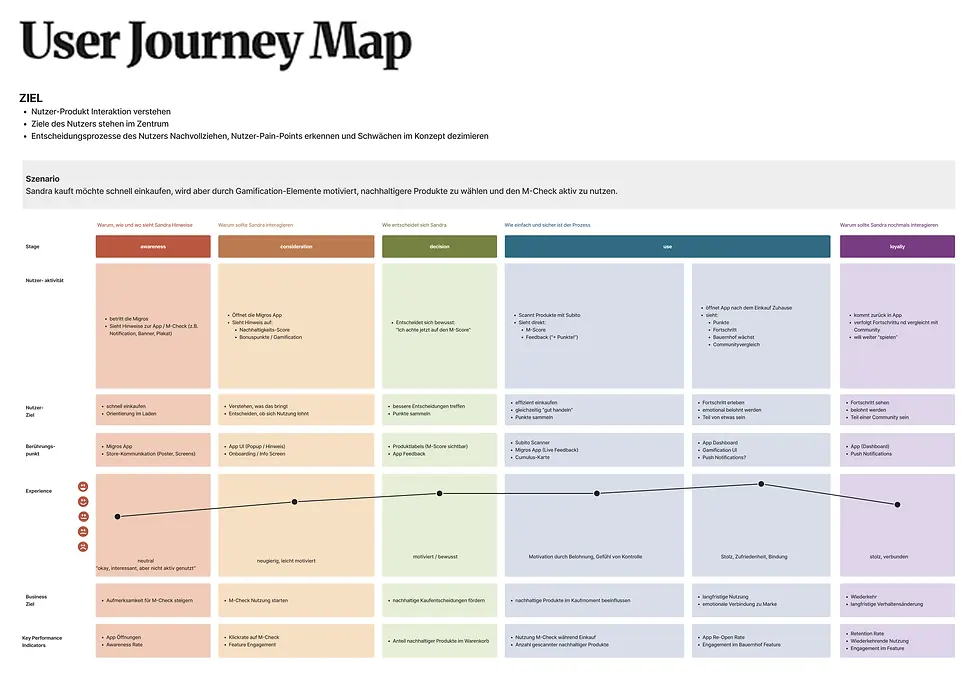
Validating personas
After defining stakeholders and target groups, I reviewed the personas provided by Migros and optimized them for the specific project. Dangerous assumptions Statements such as "M-Check is unknown" and "Sustainable shopping is a need" were specifically examined using surveys. This allowed me to validate them and, through active listening, gain a clearer picture of the needs, motives, and concerns of potential users.
How might we?
How should the sustainability indicator be positioned so that it is visible to customers with and without scanners?
How can customers be motivated to change their habits sustainably?
How can we promote sustainable purchasing behavior in the long term?
How can it be conveyed that purchasing decisions actually make a difference?
Solution approach
At the heart of our solution is an easy-to-understand sustainability indicator that is displayed directly on the scanner during shopping, making the sustainability of the current shopping basket readily apparent.
To fully address the goals of our "How Might We" questions, the experience shouldn't end at the store door. The approach extends beyond the shopping experience into the everyday lives of customers. Through gamification, shared challenges, and visible progress, sustainable decisions should not only be simplified but also made tangible and impactful in the long term.
While Shopping

Scanners with a Sustainability Score
→ Immediate Feedback
At home

Use Points in the Farm Game
→ Long-term motivation
Competition

Battle of the Migros Cooperatives
→ Sense of community
Promote customer motivation
Direct & positive feedback
Keep feedback brief and optional
Foster a sense of community
To create a feeling of making a difference
A launch campaign that includes children
Cumulus benefits
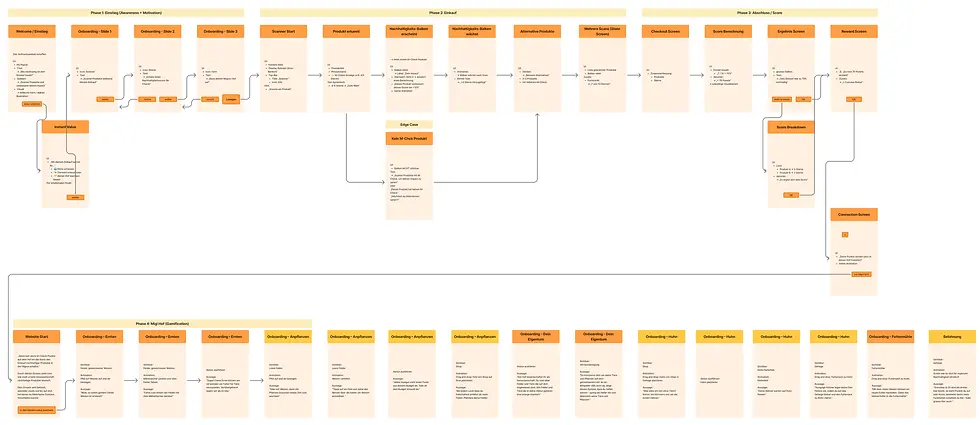
Prototyping
In developing the sustainability indicator, particular emphasis was placed on transparency and clear, easily understandable information. Customers should be able to understand at any time how their purchase is assessed and what influence individual products have on it.

Gamification focuses on long-term motivation. Animal characters, whose development depends on users' consistent behavior, visible progress, and rewards create an emotional connection and promote sustainable habits. (See video: Onboarding Game)

Challenges
Scanner
Fair Calculation
Make the calculation transparent
Communicate the significance of the score
Use animations during the shopping experience
Short tests
Game
How Much an Action Costs
Figma Limitations in Gaming sector
Meaning of the Score
Encourage Shopping: “Shop for your favorite products now to reach the next level”
What didn't work
Since many products already have a high M-Check rating, the score usually remains consistently high during the shopping process. However, this makes it difficult to see which individual products are particularly sustainable and have a positive impact on the purchase.
